

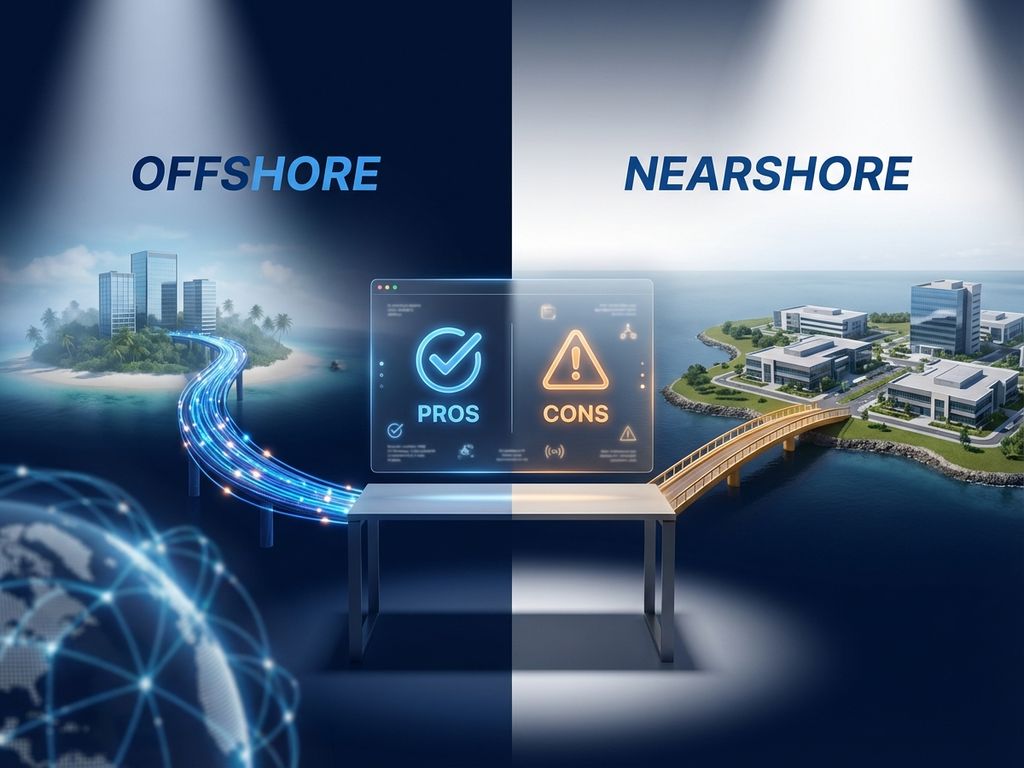
Choosing between offshore and nearshore outsourcing depends on your priorities for cost savings, communication needs, and project complexity. Offshore outsourcing typically offers greater cost reductions by partnering with teams in distant countries, while nearshore outsourcing provides closer geographical proximity with better time zone alignment and cultural similarities. Understanding the key differences, advantages, and challenges of each approach helps you make the right decision for your software development outsourcing needs.
What’s the actual difference between offshore and nearshore outsourcing?
Offshore outsourcing involves partnering with development teams in countries significantly distant from your location, typically with substantial time zone differences and lower labor costs. Nearshore outsourcing means working with teams in neighboring countries or regions with similar time zones and cultural backgrounds.
The geographical boundaries matter more than you might think. Offshore partnerships often span continents—for example, a UK company working with developers in India or the Philippines, or a US business partnering with teams in Eastern Europe or Asia. These arrangements typically offer the most significant cost advantages, with hourly rates often 60–80% lower than domestic alternatives.
Nearshore arrangements keep partnerships closer to home. European companies might work with teams in neighboring EU countries, while US businesses often partner with developers in Latin America or Canada. The cost savings are more modest, typically 30–50% compared to local rates, but other benefits compensate for the smaller financial advantage.
Time zone overlap becomes crucial for real-time collaboration. Offshore partnerships might have only 2–4 hours of overlapping business hours, while nearshore arrangements often provide 6–8 hours of shared working time. This difference significantly impacts daily communication, project meetings, and issue resolution speed.
What are the main advantages of offshore outsourcing for software development?
Cost reduction represents the primary advantage of offshore IT outsourcing, with savings of 50–70% on development costs compared to hiring locally. Access to vast talent pools and round-the-clock development cycles creates additional value for businesses seeking scalable software solutions.
The financial benefits extend beyond hourly rates. Offshore partnerships eliminate recruitment costs, office space requirements, and employee benefit expenses. You gain access to experienced developers at rates that make complex projects financially viable, allowing smaller businesses to compete with larger organizations through affordable software development.
Talent availability becomes virtually unlimited with offshore outsourcing. Countries like India, Ukraine, and the Philippines have developed substantial technology sectors with hundreds of thousands of skilled developers. This massive talent pool means you can find specialists in virtually any programming language or technology stack, from common frameworks to niche enterprise solutions.
The time zone difference that creates communication challenges also enables continuous development cycles. While your team sleeps, offshore developers continue working on your project. This 24-hour development cycle can accelerate project timelines significantly, particularly for larger software development initiatives.
Scalability becomes effortless with established offshore partnerships. You can rapidly expand your development team for large projects, then scale back for maintenance phases. This flexibility proves invaluable for businesses with fluctuating development needs or seasonal project demands.
What challenges do companies face with offshore outsourcing?
Communication barriers and time zone complications create the most significant challenges in offshore outsourcing relationships. Cultural differences, quality control concerns, and complex project management requirements can impact project success if not properly addressed.
Language differences often create subtle but important communication issues. Even when offshore teams speak excellent English, nuances in requirements, technical discussions, and project feedback can be misunderstood. These communication gaps can lead to development work that doesn’t quite match expectations, requiring additional revision cycles.
Time zone management requires careful planning and often personal sacrifice. Important discussions, urgent bug fixes, and project meetings frequently happen outside normal business hours for one party. This can create stress for internal teams and slow down decision-making processes.
Quality control becomes more complex when you cannot easily visit the development team or observe their working practices directly. Establishing reliable quality assurance processes, code review procedures, and project monitoring systems requires more formal structure than local partnerships.
Cultural differences can impact working relationships and project approaches. Different attitudes toward deadlines, hierarchy, feedback, and problem-solving can create friction if not acknowledged and managed appropriately. Building strong working relationships takes more effort and cultural sensitivity.
Project management overhead increases substantially with offshore arrangements. You need more detailed documentation, formal communication processes, and structured project tracking to maintain visibility and control over development progress.
How does nearshore outsourcing compare in terms of benefits and drawbacks?
Nearshore outsourcing provides better communication, overlapping time zones, and cultural alignment while offering moderate cost savings. However, it typically costs more than offshore alternatives and provides access to smaller talent pools in specific geographical regions.
Communication quality improves dramatically with nearshore partnerships. Shared time zones mean most communication happens during normal business hours for both parties. Cultural similarities reduce misunderstandings, and often shared languages or closer linguistic relationships improve technical discussions and requirement clarification.
Travel becomes practical with nearshore arrangements. You can visit your development team for important project phases, team building, or complex requirement discussions. This face-to-face interaction builds stronger relationships and improves project understanding.
Legal and regulatory alignment often works better with nearshore partnerships. Similar business practices, intellectual property protections, and regulatory environments reduce legal complexity and risk. Data protection requirements are often more aligned, particularly within regions like the European Union.
However, cost savings are more limited with nearshore outsourcing. While you still achieve significant savings compared to local hiring, the reductions are typically 30–50% rather than the 60–80% possible with offshore arrangements. For budget-conscious projects, this difference can be substantial.
Talent pool limitations become apparent in nearshore arrangements. You’re restricted to developers in specific neighboring countries or regions, which might not have the specialist skills or capacity you need. Popular nearshore destinations can become expensive as demand increases.
Which outsourcing model should you choose for your software project?
Choose offshore outsourcing for maximum cost savings, access to specialized skills, and projects where communication can be structured and formal. Select nearshore outsourcing when real-time collaboration, cultural alignment, and moderate cost reduction meet your project needs better than maximum savings.
Project complexity influences the best choice significantly. Simple, well-defined projects with clear requirements work excellently with offshore teams. Complex projects requiring frequent stakeholder input, iterative development, and regular requirement changes benefit from nearshore partnerships with better communication flow.
Budget constraints often determine the decision. If cost reduction is your primary concern and you can invest time in establishing robust communication processes, offshore outsourcing delivers maximum financial benefits. When budget allows for moderate savings in exchange for easier collaboration, nearshore arrangements prove worthwhile.
Your team’s experience with remote collaboration matters considerably. Companies new to software development outsourcing often find nearshore partnerships easier to manage initially. Experienced organizations with established remote working processes can successfully leverage offshore advantages.
Consider your industry’s regulatory requirements carefully. Heavily regulated sectors like finance or healthcare might benefit from nearshore partnerships with similar legal frameworks. Less regulated industries can take advantage of offshore cost benefits more easily.
Timeline expectations should influence your choice. Projects requiring rapid iteration and frequent feedback cycles work better with nearshore teams. Longer-term projects with defined phases can utilize offshore advantages effectively with proper planning and structured communication.
The decision ultimately depends on balancing cost savings against communication needs, project complexity, and your organization’s capability to manage remote relationships effectively. Both models can deliver excellent results when matched appropriately to project requirements and business objectives.
