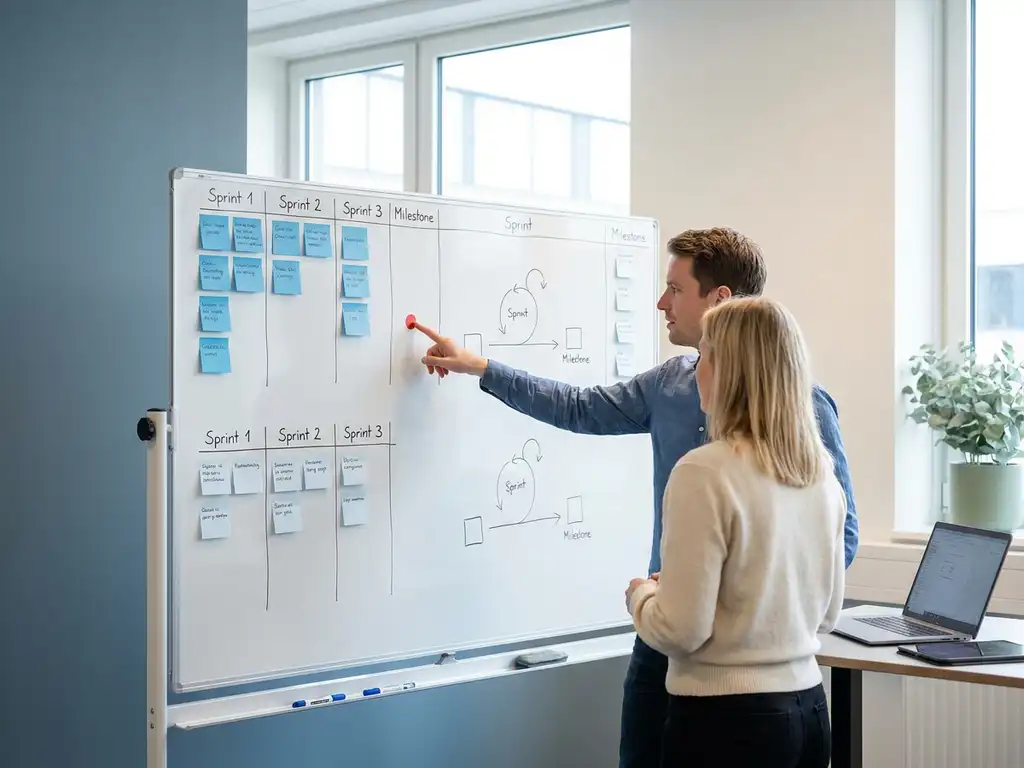
As a client, staying involved during a software development project means scheduling regular communication moments, making progress visible through shared tools, and actively providing feedback during each iteration. Involvement isn’t about checking in daily, but about structured collaboration at the right moments. In this article, we answer the most frequently asked questions about how you as a client can maintain control over an ongoing development project.
What communication structure works best for remote development?
The most effective communication structure for remote software development combines fixed weekly meetings with a shared project board and brief daily updates via chat. This gives you as a client an overview without having to log in constantly. A fixed structure prevents miscommunication and ensures everyone is on the same page.
In practice, a combination of the following elements works well:
- Weekly video call of 30 to 60 minutes for progress discussion and priorities
- Shared project board (such as Jira, Trello, or Notion) where tasks, status, and deadlines are visible
- Asynchronous updates via Slack or Teams for daily questions and brief alignment
- Bi-weekly demo of delivered functionality, so you can concretely see what has been built
The advantage of a fixed structure is that you as a client don’t have to search for information. It comes to you at predictable moments. This is especially relevant in remote development, because you can’t just catch the team in the hallway.
How do you as a client know whether the project is on schedule?
You know whether a software project is on schedule by measuring progress against concrete deliverables, not hours or activity. At each meeting, ask which features have been completed, what the next milestone is, and whether there are any risks affecting the timeline.
Concrete signs that a project is on schedule:
- Features are delivered as agreed in the sprint or phase
- Bugs and bottlenecks are reported transparently, not kept hidden
- The backlog is up-to-date and reflects current priorities
- Deadlines are discussed as soon as there is a risk of delay
A healthy project always has a current schedule that you as a client can review. If you only receive that schedule upon request or if answers remain vague, that is a signal to start a conversation about transparency.
What is the role of a fractional CTO in a development project?
A fractional CTO guides the development project at a technical and strategic level, without you as a client needing to have technical knowledge yourself. He or she translates your business goals into technical decisions, monitors code quality, and serves as the point of contact between you and the development team.
In practice, a fractional CTO fulfills multiple roles simultaneously:
- Technical advisor: helps with decisions around architecture, technology stack, and scalability
- Quality guardian: ensures code reviews take place and that work is carried out according to good standards
- Communication bridge: translates technical updates into understandable language for the client
- Risk manager: identifies technical risks early and proposes alternatives
Especially in remote development, the fractional CTO is invaluable. You have someone who knows the team, speaks the language, and looks out for your interests. That provides peace of mind, even if you’re not a programmer yourself.
How do you provide feedback during an ongoing software project?
Good feedback during a software project is concrete, timely, and focused on the desired outcome. Avoid vague comments like “this doesn’t work well” and instead describe what you expect, what you see, and in what context the problem occurs.
A practical format for effective feedback:
- Describe what you see: “When I press the button, nothing happens.”
- Describe what you expect: “I expect the form to be submitted and the user to see a confirmation page.”
- Provide context: “This only happens on mobile; on desktop it works fine.”
- Assign priority: Is this a blocker, or can it be addressed in the next sprint?
Feedback is best provided during the demo or via the project board, not through separate messages or emails that fall outside the system. This keeps all information in one place and allows the team to act on it efficiently.
How much time should a client invest in a development project?
As a client, expect to invest two to four hours per week in an active development project. This includes the weekly meeting, reviewing updates, providing feedback, and making decisions about priorities. Less than this often leads to delays because the team is waiting for answers.
The time investment varies by phase of the project:
- Startup phase: more time needed for documenting requirements, technical decisions, and expectations (four to six hours per week)
- Development phase: two to three hours per week for meetings, feedback, and decisions
- Testing phase: more involvement needed for evaluating functionality and reporting findings
- Delivery and aftercare: limited, but available for quick alignment
Involvement is not a burden, it’s an investment. Clients who actively think along deliver projects that better match their actual needs.
What are signs that the collaboration is not going well?
Signs that a software development collaboration is not going well include unclear communication, missed deadlines without explanation, and the feeling that you as a client have to chase down information. These signals are important to recognize early, so you can course-correct in time.
Watch out for the following warning signs:
- Updates only come when you ask for them, never proactively
- Deadlines are shifted without a clear reason or alternative plan
- Delivered functionality consistently deviates from what was agreed
- Technical explanations are always vague or hard to understand, even after follow-up questions
- Feedback disappears into a black hole and is never acted upon
- Team members change regularly without you being informed
If you recognize several of these signs, an open conversation is the first step. Name what you see and ask for concrete agreements. If there is no response, it is wise to reconsider the collaboration.
How we help you stay involved during your development project
At 3Bird, we believe that client involvement is not a side issue, but a core part of how good software development works. That’s why we build that involvement into our approach.
What you can expect from us:
- A Dutch fractional CTO as your dedicated point of contact who guides the team and keeps you informed in plain language
- Fixed meeting moments and transparent project tools so you always know where the project stands
- Flexible teams of experienced developers that you can scale up or down based on the project phase
- Communication in Dutch, so there is no language barrier between you and the team
- Rates from €25 to €30 per hour, with the quality you’d expect from a local team
Want to know how we approach your project and how we ensure that you as a client always stay in control? Get in touch with us at contact@3bird.nl or call +(31)75-7993038. We’d love to think along with you.
Related Articles
- How is feedback processed during a development trajectory?
- What are signs that outdated software is holding a business back?
- What certifications should IT outsourcing vendors have?
- How do you manage software licenses in multi-vendor outsourcing?
- How do you handle dispute resolution in IT outsourcing contracts?