An idea is concrete enough to have built once you can describe what it does, for whom, and why. You don’t need a ready-made design or technical specifications, but you do need a clear picture of the problem you’re solving and who will use it. In this article, we answer the most frequently asked questions about turning an idea into a software project.
What information does a developer need at minimum?
A developer needs at least three things to get started: a description of the problem the software solves, a description of the target user, and a rough list of features the software should include. Without these three elements, it’s impossible to make a realistic estimate of time, cost, and technical approach.
You don’t need to phrase this in technical jargon. A few pages of plain language are often enough to have an initial conversation. Think about questions like:
- What does the user do now, and what should the software do differently or better?
- Who uses the software: customers, employees, or both?
- What actions should a user be able to perform?
- Are integrations needed with other systems, such as a payment provider or a CRM?
The more concrete your answers, the faster a developer can give an honest estimate. But remember: you don’t need to know everything before you start. A good development team will help you fill in the missing pieces.
Do you need a design before you start?
No, you don’t need a design before having an initial conversation with a developer. A sketch on paper or a rough description of the screens you have in mind is more than enough as a starting point. A fully worked-out design is only needed in a later phase of the project.
What does help is thinking about the user experience: how does someone navigate through the application? What is the first action a user takes? What information does someone see on the screen? You don’t need to work this out visually, but if you can describe it, it gives a developer a lot to work with.
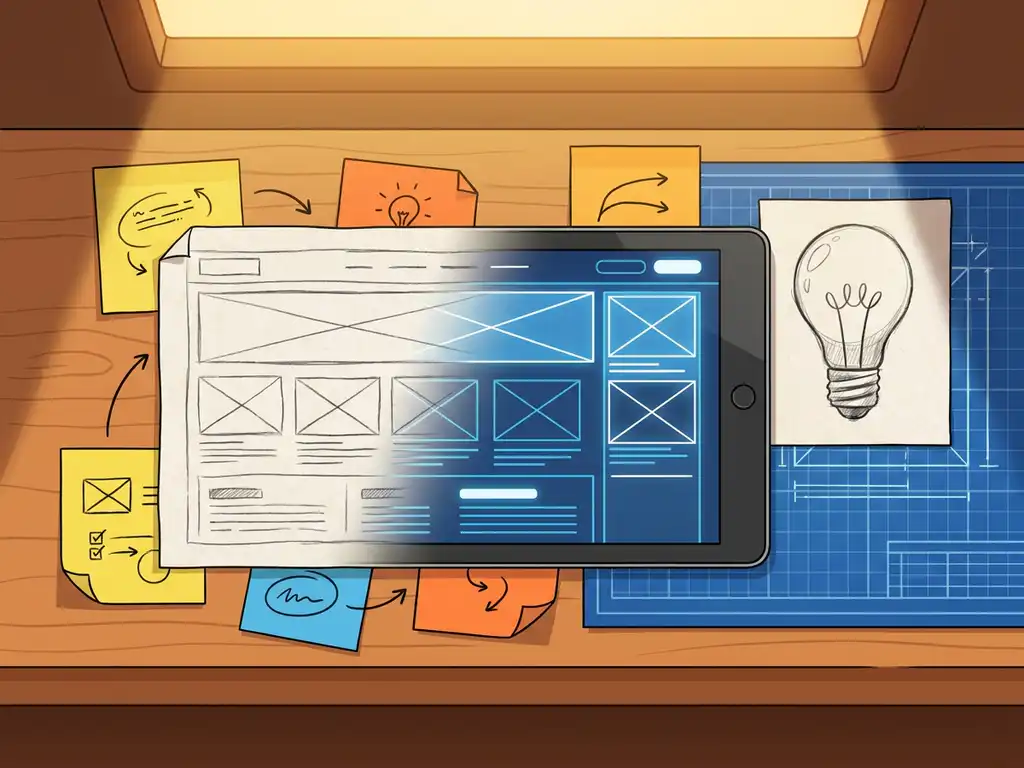
In practice, many projects work with a design that is developed in parallel with development. A wireframe (a rough sketch of the screen layout) is often sufficient to get started. Professional tools like Figma or even a drawing pad can serve this purpose.
How do you know if your idea is technically feasible?
Most software ideas are technically feasible. The real question is whether they are feasible within your budget and timeline. Technical feasibility depends on the complexity of the features, the required integrations, and the scale at which the software needs to operate.
A few signals that your idea may be technically complex:
- You need real-time data, such as live inventory updates or chat functionality
- You want to integrate with external systems that don’t have a standard API
- You expect large numbers of users or data in a short period of time
- The software needs to run on multiple platforms simultaneously, such as iOS, Android, and web
The best way to assess feasibility is a conversation with an experienced developer or technical advisor. They can quickly assess which parts are standard and which require custom work. A technical exploration of a few hours can save you a lot of time and money later in the process.
What is the difference between an MVP and a full product?
An MVP (Minimum Viable Product) is the most basic version of your software that already delivers value to users. It contains only the features that are strictly necessary to solve the core problem. A full product additionally contains extra features, refinements, and optimizations that improve the user experience but are not immediately necessary.
The difference is not in quality, but in scope. An MVP is deliberately limited, so you can quickly test whether the idea works before making large investments. Think of the difference between a car and a bicycle: both get you from A to B, but the bicycle is faster to build and cheaper to test.
Practical examples of what is and isn’t in an MVP:
- In an MVP: user registration, core functionality, basic administration
- Not in an MVP: advanced reporting, extensive notifications, integrations with secondary systems
For most software development projects, we recommend starting with an MVP. You quickly learn what users really need, and you avoid investing months in features that nobody uses.
When is an idea still too vague to get a quote?
An idea is too vague for a quote if you still can’t describe what the software should do and for whom. If the answer to “what does it do?” is still “something with AI” or “a kind of platform,” then more elaboration is needed first. A quote without a clear scope is not a quote, but a guess.
Concrete signals that your idea is still too vague:
- You can’t describe the target user
- You have no idea which features are truly necessary
- You don’t know whether the software works standalone or needs to connect with other systems
- You still don’t have an answer to the question: what does a user do first after logging in?
That doesn’t mean you have to work it all out yourself. A good software development partner will help you go from a vague idea to a concrete specification. This can be done through a discovery conversation, a workshop, or a short exploration phase. That way, you quickly know where you stand and what it will cost.
How 3Bird helps you go from idea to concrete project
At 3Bird, we understand that not every idea is ready-made when you approach us. It doesn’t have to be. We help you step by step to concretize your idea, assess it technically, and turn it into a feasible software project.
This is what we do for you:
- Discovery conversation: we listen to your idea and ask the right questions to clarify the scope
- Technical feasibility check: our experienced developers assess what is realistic within your budget and timeline
- MVP advice: we help you determine which features are truly necessary for a first version
- Flexible team: you can scale up and down with developers from €25 per hour, guided by Dutch fractional CTOs
- Custom software development: from front-end to back-end, built on more than 25 years of experience
You always work in your own language, with short lines of communication and no hassle over time zones or miscommunication. Ready to make your idea concrete? Get in touch via contact@3bird.nl or call us at +(31)75-7993038 for a no-obligation conversation.
Related Articles
- What does a discovery phase entail in software development?
- What is normally included in a contract with a software company?
- How does custom software compare to existing SaaS solutions?
- What is the difference between maintenance and further development?
- What is the difference between fixed-price and time-and-materials contracts?